
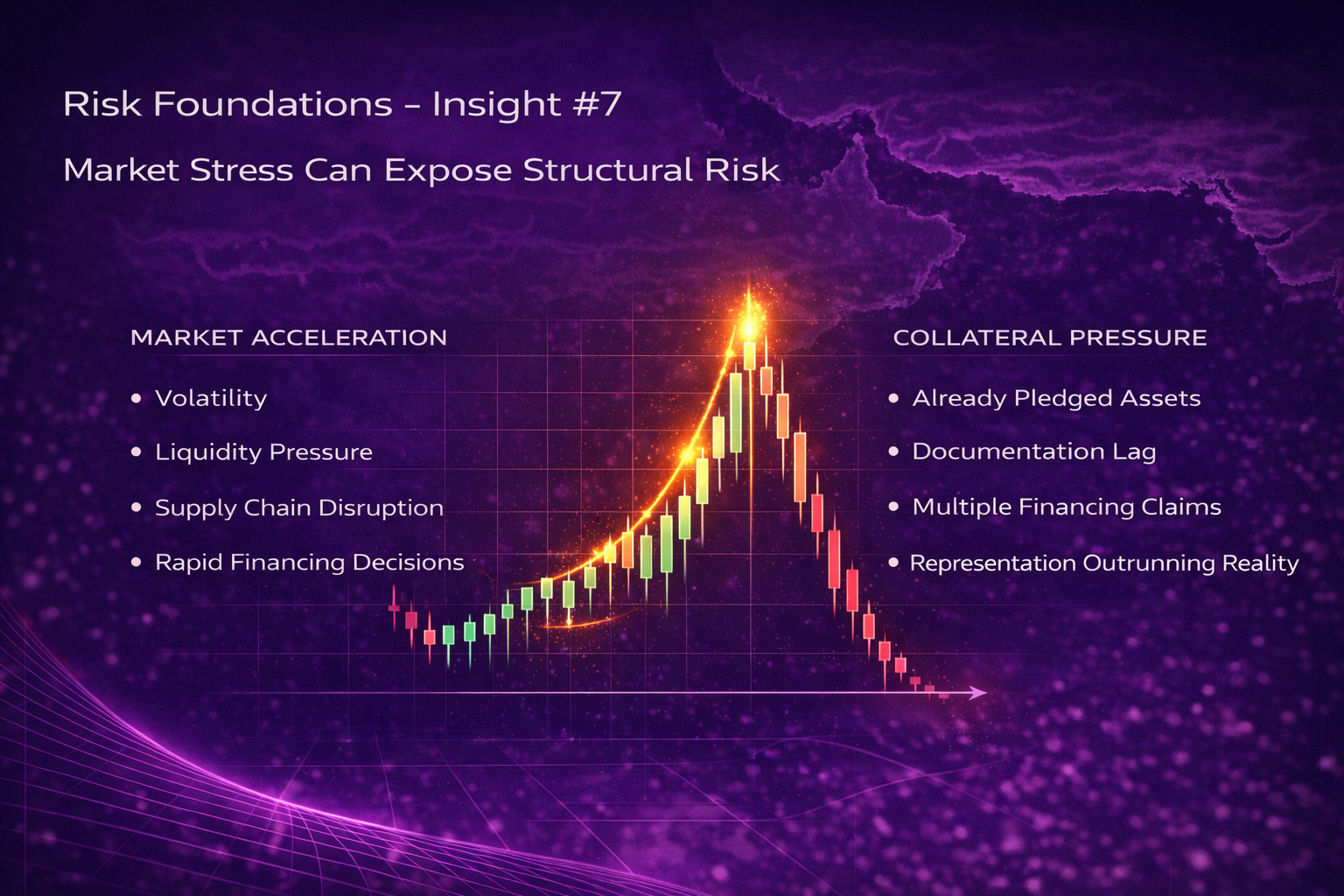
Earlier insights in this series examined how commodity risk forms — why inventory only exists while continuously constrained, why location must be proven first, why documentation must be tied to verified existence, and why verification cannot persist without a persistent identity. This insight considers another structural dynamic: how periods of market stress can expose weaknesses already present within commodity systems, forcing the moment when representation must reconcile with reality

Recent geopolitical tensions involving Iran and the disruption of shipping through the Strait of Hormuz illustrate how quickly market stress can enter commodity markets.
The strait carries roughly one-fifth of the global oil supply. When tensions escalated and tanker traffic slowed, vessels began anchoring outside the Gulf awaiting safe passage. Insurance coverage tightened, shipping rates surged, and oil prices reacted immediately.
Within days:
The physical movement of commodities continued.
But the mechanisms used by the market to verify collateral — inspections, documentation cycles, collateral reporting, and audit processes — do not accelerate at the same pace as market activity.
When markets move faster than the mechanisms designed to verify them, representation begins to outpace enforceability.
As market pressure accelerates:
Market shocks do not create collateral risk.
They expose when reliance moves faster than verification.
Commodity markets are heavily dependent on financing.
Periods of volatility introduce immediate financial pressure:
At the same time, operational conditions become more volatile:
Organisations are forced to make decisions more quickly.
Yet the mechanisms used to verify physical collateral — inspections, reconciliation processes, and documentation cycles — typically remain periodic.
This creates a structural gap.
Reliance begins to move faster than verification.
In many historical commodity losses, counterparties did not begin with fraudulent intent.
Financial stress often develops gradually, increasing reliance on collateral that may already have been pledged or used to support other financing arrangements.
Under liquidity pressure, firms may become increasingly dependent on the assets available to them.
Inventory that has already supported financing, moved through the supply chain, or been partially sold may still appear available within documentation cycles that lag physical reality.
Over time, multiple institutions may believe they hold enforceable claims against the same underlying assets.
Many of the largest commodity losses did not begin with fabricated collateral.
They began with real assets that gradually supported more financing than the underlying physical collateral could ultimately sustain.
As seen in many historical commodity losses:
Collateral rarely fails because it never existed.
It fails when the same assets support more financing than they can sustain.
Commodity markets and physical commodity operations are inherently dynamic.
Verification mechanisms, however, remain largely periodic.
They rely on:
These processes confirm what was true at a moment in time.
They do not ensure those conditions remain enforceable when reliance occurs.
In stable markets, the gap between representation and reality may remain manageable.
Under stress, that gap can widen rapidly.
Market disruptions do not only affect commodity flows.
They can also affect the ability to verify them.
During geopolitical crises, travel restrictions, security risks, insurance limitations, and disrupted transport routes can delay the ability of independent inspectors, surveyors, and auditors to reach physical locations.
Flights may be cancelled.
Shipping routes may be restricted.
Access to certain facilities may become limited.
Verification cycles may therefore extend beyond their intended schedule.
Organisations may temporarily rely more heavily on operator reporting, historical documentation, or previously issued inspection records while awaiting independent verification.
This is often unavoidable.
But it introduces an additional structural risk.
The mechanisms responsible for verifying physical collateral may slow precisely as operational conditions are changing most rapidly.
As verification becomes more difficult, reliance increasingly shifts toward representation.
Under market stress, this shift can widen the gap between documentation and enforceable physical reality.
Disruptions such as the current tensions around the Strait of Hormuz illustrate how quickly physical commodity flows can accelerate.
Cargoes may be delayed, rerouted, or resold while still at sea.
Inventory locations shift rapidly.
Financing exposure increases as prices and volatility rise.
Yet many financing decisions continue to rely on documentation created days or weeks earlier.
The physical movement of commodities continues regardless of documentation cycles.
Verification remains episodic.
This mismatch creates the conditions where representation can drift from enforceable reality.
Fraud in commodity markets is often described as deception.
More often, it begins with structural misalignment.
Liquidity pressure accelerates reliance.
Verification does not accelerate at the same pace.
Collateral may still appear valid on paper, even though the conditions that supported it may have changed.
Market shocks do not create these structural weaknesses.
They expose them.
Collateral becomes reliable only when its enforceability can be continuously constrained.
This requires the ability to:
Without these mechanisms, collateral exclusivity must be inferred rather than enforced.
Under market stress, inference becomes increasingly fragile.
The next generation of market infrastructure will increasingly focus on enforcing physical reality continuously — rather than relying solely on periodic verification and documentation cycles.
This shift moves risk management upstream, constraining exposure before reliance becomes binding.
Fraud can develop under many market conditions.
Periods of volatility often compress time, forcing processes built for periodic verification to operate under pressure.
As reliance begins to move faster than verification, representation can outpace reality.
Reliance moves at the speed of markets.
Verification moves at the speed of process.
Collateral rarely fails because it disappears.
It fails when multiple parties rely on the same asset before its enforceability has been structurally constrained.
Market shocks do not create fraud.
They reveal environments where truth was never continuously enforced in the first place.
Disclaimer
This article is intended for general informational and educational purposes only. It discusses observed industry patterns and structural risk considerations and does not constitute legal, financial, or investment advice. References to losses or failures are illustrative and non-exhaustive, and do not refer to any specific organisation unless expressly stated.