
This article examines why large commodity losses rarely begin with a single failure but instead emerge when inventory is treated as a static fact, physical environments continue to change, and assumptions about existence are relied upon without being continuously enforced.

Inventory does not fail when it goes missing.
The loss is the outcome — not the failure.
In physical commodity markets, failure occurs earlier, when inventory is relied upon as real before its existence has been sufficiently constrained.
Once inventory is recorded, inspected, or certified, it is often treated as a fact that persists unless explicitly disproven. From that point onward, it becomes embedded in financing decisions, collateral reliance, insurance coverage, and operational assumptions.
By the time discrepancies are discovered, exposure has already formed.
Inventory is not a static object.
It is a state.
That state exists only while the physical and operational conditions that define it continue to hold.
In dynamic environments, existence does not persist by default. It must be continuously constrained.
Most frameworks implicitly assume that once inventory has been counted, documented, inspected, or reconciled, its existence can be relied upon until something explicitly invalidates it.
This assumption is rarely stated, but it underpins how inventory is financed, insured, traded, and relied upon as collateral.
The issue is not that this assumption is careless.
It is that it is structurally incomplete.
Inventory does not persist by default.
It persists only while it remains constrained.
Not all major commodity losses involve inventory that once existed and later disappeared.
In some cases, the inventory did not exist in the first place.
In others, inventory existed initially but ceased to be enforceable as conditions changed.
This distinction does not change the underlying failure.
In both scenarios, exposure arose because existence was inferred rather than enforced.
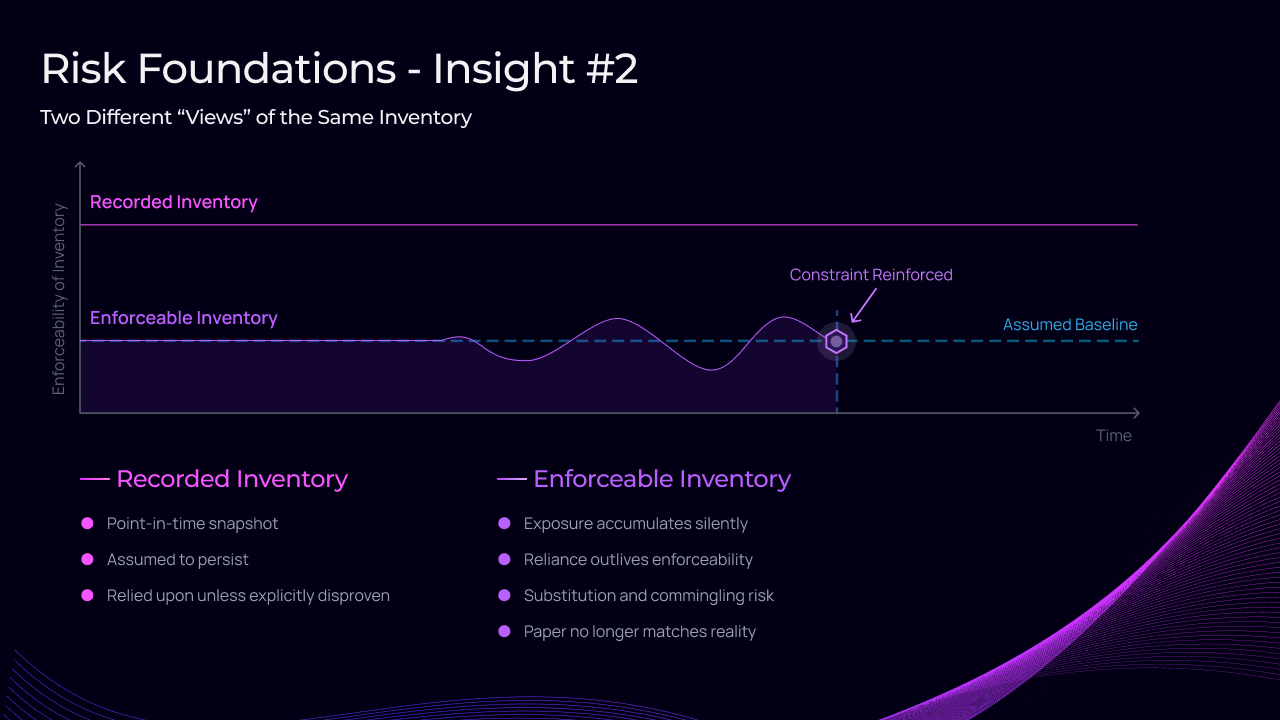
Recorded inventory is a representation.
It reflects what was observed, where it was believed to be located, and under which controls it was reviewed — at a specific point in time. Once recorded, it is typically:
Enforceable inventory is different.
It exists only while the constraints that define it continue to hold.
Physical storage environments are not static.
These changes are not exceptional — they are normal operating conditions.
What is exceptional is expecting representations of inventory to remain valid while the environment that defines them is continuously changing.
Most frameworks are designed to detect exceptions, not drift.
As a result, enforceability weakens quietly over time:
Nothing necessarily breaks at a single moment.
The issue becomes visible only when reconciliation is forced — often after decisions have already become binding.
Static frameworks applied to dynamic physical environments do not manage risk — they delay its discovery.
Inventory can be relied upon only while the conditions that define it remain valid.
When those constraints weaken or expire, inventory may still exist on paper — but it is no longer enforceable.
Constraint matters only if it remains valid over time and cannot be reused beyond its original context.
Re-enforcement is the point at which reliance is either restored or withdrawn.
The costliest failures in physical commodity markets do not occur because inventory goes missing.
They occur because inventory — whether initially present or never present at all — is treated as real without enforcing the conditions required for its existence.
When inventory is understood as a governed state rather than a recorded number, the focus shifts:
Inventory does not exist because it was recorded.
It exists only while the conditions that define it continue to hold.
This does not require more documentation or more frequent counting.
It requires a change in how existence itself is treated.
Inventory should not be assumed to exist until disproven.
It should be treated as something that exists only while its defining constraints continue to hold.
The next generation of risk systems will be built around enforcing physical reality first — and allowing reliance only where that reality remains continuously constrained.
That shift moves risk management upstream — from explaining outcomes after exposure has formed, to enforcing reality before reliance becomes binding.
When existence is enforced rather than inferred, exposure is constrained earlier, misalignment is surfaced sooner, and losses are less likely to accumulate silently.
Whether inventory was fabricated or allowed to decay, exposure formed because existence was inferred — not enforced.
Inventory does not fail when it goes missing.
It fails when systems continue to rely on it after enforceability has expired — or when existence was never enforced at all.
Sphere is carving a new path as the first next-generation system built for this reality. Using sophisticated AI models, Sphere makes continuous enforcement of existence possible, anchoring inventory, controls, and evidence to physical reality as conditions change.
This is not an incremental improvement.
It is a fundamental shift in how risk is governed — and the direction the market is now being forced to move.
Disclaimer
This article is intended for general informational and educational purposes only. It discusses observed industry patterns and structural risk considerations and does not constitute legal, financial, or investment advice. References to losses or failures are illustrative and non-exhaustive, and do not refer to any specific organisation unless expressly stated.