In earlier insights, we explored when risk forms, why inventory only exists while continuously constrained, and why location must be proven first. This piece moves one step further: even when place and inventory are validated, trust can still drift if documentation is not anchored to continuously verified reality.

Documentation is often treated as evidence — receipts, certificates, inspection reports, and signed statements. But documentation is not evidence. It is a record. A record describes what was observed at a moment in time. It does not ensure those conditions remain true afterwards.
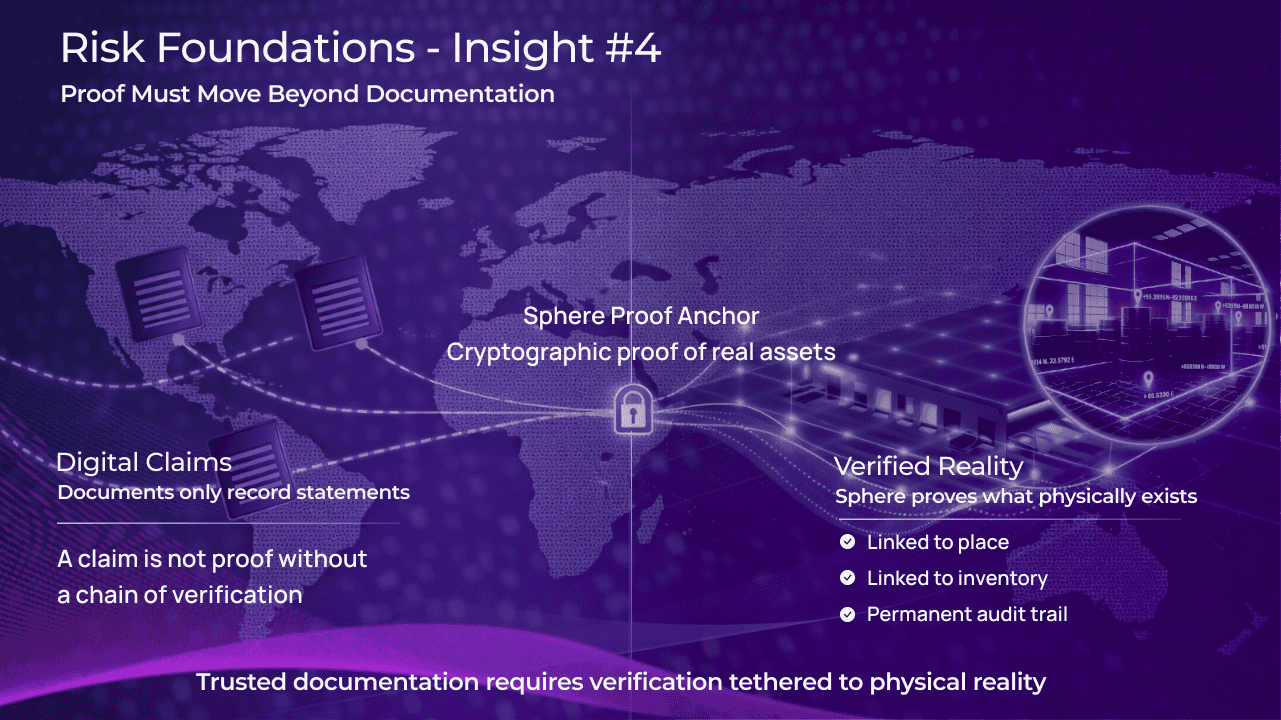
If documentation is not physically bound to what it represents, it becomes a claim rather than proof.
Most assurance frameworks follow the same sequence. They observe conditions, produce documentation, and then rely on that documentation until the next review. The sequence appears logical. It is also incomplete.
Nothing binds the document to the conditions it was meant to describe.
Once created, a document travels independently of location and persists across time. It may remain valid even when the physical state it describes has changed. Assets move. Controls weaken. Inventory is altered. The document does not.
Paper has memory. Reality does not.
Documentation records what was true.
It does not guarantee what remains true.
Documentation can remain internally consistent while physical conditions drift. Records reconcile and reports appear complete, yet the underlying asset may no longer be enforceable. When reliance persists beyond enforceability, exposure forms.
Documentation in commodity markets is not abstract. It carries legal and financial consequence. Warehouse receipts, storage certificates, inspection reports, stock statements, collateral schedules, insurance declarations, and audit confirmations are relied upon to release goods, extend credit, insure exposure, and support title and collateral claims.
Many of these instruments are treated as definitive. Original warrants or receipts are often held in bank custody, secured in vaults as perfected collateral. Legal control is therefore strong. Physical control is not.
The document can be secured. The asset it represents cannot.
There is no mechanism for a third party standing at the site to immediately verify that the material in front of them corresponds to the documents held in custody, often thousands of miles away. The linkage exists on paper, not in the physical world.
Even when documentation is digitised or encrypted, the limitation remains. Encryption protects the record. It does not prove the asset.
Without continuous verification, documentation becomes representation rather than proof.
Observation captures a moment. Evidence remains enforceable.
An inspection confirms what was seen. It does not ensure that the same conditions still hold tomorrow. Evidence exists only while constraints continue to hold — while location is verified, inventory is bounded, and controls remain effective. When those constraints weaken, enforceability expires.
Documentation often persists beyond those limits. This gap allows exposure to accumulate quietly between review cycles.
Observation describes.
Evidence constrains.
Physical environments are continuous. Inventory moves. Access changes. Processes drift. Risk evolves. Documentation is periodic.
Static records applied to dynamic systems create unavoidable gaps. By the time a report is written, reality has already moved on. By the time discrepancies surface, reliance has already occurred.
Static documentation applied to dynamic physical environments
does not create trust — it delays discovery.
Documentation remains necessary. It is the language of trade, finance, insurance, and audit. But it cannot be the foundation of trust.
What is missing is a layer that binds documentation to verifiable existence at the moment it is relied upon — anchoring each document to a specific place, a defined inventory state, and a limited period of validity. When conditions change, reliance must change with them.
When records are connected through enforceable relationships rather than treated as isolated files, trust becomes structural rather than assumed.
This is not a shift away from documentation. It is a shift beneath it.
Documents remain the interface.
Evidence becomes the foundation.
Documentation expresses what is claimed. Proof enforces what is physically possible.
Documentation alone cannot create trust; it can only record what was observed, while trust exists only where existence is continuously verified, and place, inventory, controls, and records are bound together as one enforceable system that links all parties across the ecosystem — the foundation on which Sphere is built.
Key principles
Disclaimer
This article is intended for general informational and educational purposes only. It discusses observed industry patterns and structural risk considerations and does not constitute legal, financial, or investment advice. References to losses or failures are illustrative and non-exhaustive, and do not refer to any specific organisation unless expressly stated.