
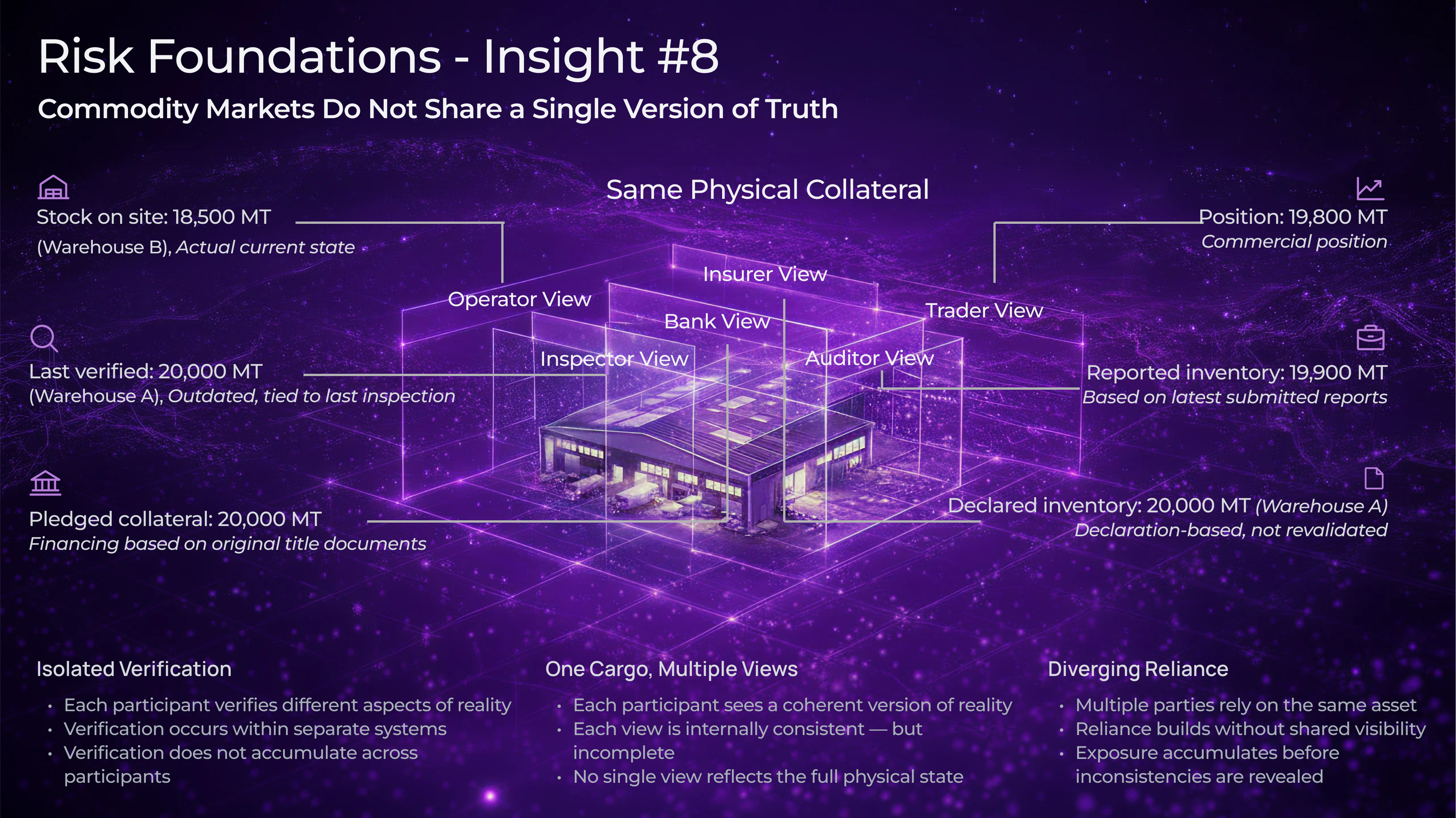
Earlier insights explored how risk forms, why inventory depends on continuous constraint, why location must be proven, and how verification and documentation can fail to persist across systems. This piece examines a deeper issue: even when organisations verify correctly, commodity markets lack a shared, continuously enforceable version of physical truth. Without shared truth, reliance becomes fragmented.

Commodity markets involve many independent participants:
Each participant verifies parts of reality relevant to their role.
Inspectors verify quantity and condition.
Operators verify storage and operations.
Banks verify collateral documentation.
Auditors review records and controls.
Each verification may be legitimate.
But these verification events rarely operate on the same continuously shared foundation.
Instead, each organisation builds its own internal version of truth.
Because verification is fragmented, multiple parties can simultaneously hold internally consistent but incomplete views of the same physical asset.
A bank may believe collateral exists because documentation and inspections support it.
An insurer may believe coverage is valid because declarations and policy conditions appear satisfied.
A trader may believe inventory remains available because internal records show it as unsold.
Each view may appear reasonable in isolation.
Yet none of them necessarily reflects the full physical reality.
This is not deception.
It is fragmentation.
When verification occurs in isolation:
Fragmentation does not immediately create failure.
It creates the conditions where failure can accumulate quietly.
When truth is fragmented, reliance becomes layered.
Different parties may rely on the same physical assets without visibility into one another’s exposure.
Inventory may appear valid within multiple independent systems.
Documentation may remain internally consistent across several organisations.
But the underlying physical asset may only support one enforceable claim.
Exposure can accumulate gradually — often without any single participant seeing the full picture.
Most verification in commodity markets occurs bilaterally.
A lender verifies collateral with a borrower.
An inspector verifies inventory with an operator.
An auditor verifies records within a firm.
These relationships produce many verification events.
But they do not produce a shared state of truth.
Each verification exists inside a relationship rather than across the ecosystem.
As a result, inconsistencies may only surface when disputes arise or when reconciliation is forced.
It is important to recognise that this fragmentation is not the result of poor governance.
Commodity markets were never designed to operate on a shared infrastructure for physical truth.
Information flows through:
Each participant maintains their own records.
Verification events occur within those systems rather than across them.
The result is a market where truth is distributed, but not synchronised.
When verification cannot accumulate across participants:
Trust must be recreated repeatedly.
Reality must be rediscovered over and over again.
Physical commodity environments are dynamic.
Verification events, however, remain periodic and fragmented.
By the time information travels across organisations, physical conditions may already have changed.
This creates a structural delay between:
That delay is where exposure forms.
A shared version of truth does not mean centralising all information.
It means anchoring verification events to a common, enforceable physical identity and making the resulting state visible across the ecosystem.
When infrastructure, inventory, and verification events are bound to persistent identity and continuously updated conditions, verification becomes cumulative rather than isolated.
Different participants no longer maintain independent assumptions about reality.
They reference the same continuously verified foundation.
Trust moves from fragmented observation to shared enforcement.
Commodity markets have historically operated through:
As markets grow more complex and documentation becomes easier to fabricate, these mechanisms are reaching their limits.
The next generation of market infrastructure will focus on:
This does not eliminate institutions or verification roles.
It allows their work to accumulate into a shared, continuously verifiable reality.
Commodity markets do not lack verification.
They lack a shared foundation where verification can persist and accumulate across participants.
Without that foundation, each organisation recreates its own version of truth.
And when those versions diverge, exposure forms.
Markets cannot operate on fragmented truth forever.
Trust becomes durable only when physical reality is anchored to a shared, continuously enforceable state — where infrastructure, inventory, controls, and documentation remain bound to persistent identity and continuously verified conditions.
Sphere is the first platform designed to provide that foundation.
By anchoring physical infrastructure to persistent geospatial identity and continuously verifiable constraints, Sphere allows verification to accumulate rather than reset — enabling markets to rely on enforceable physical truth rather than fragmented representations.
When truth persists, trust becomes structural.
Disclaimer
This article is intended for general informational and educational purposes only. It discusses observed industry patterns and structural risk considerations and does not constitute legal, financial, or investment advice. References to losses or failures are illustrative and non-exhaustive, and do not refer to any specific organisation unless expressly stated.