
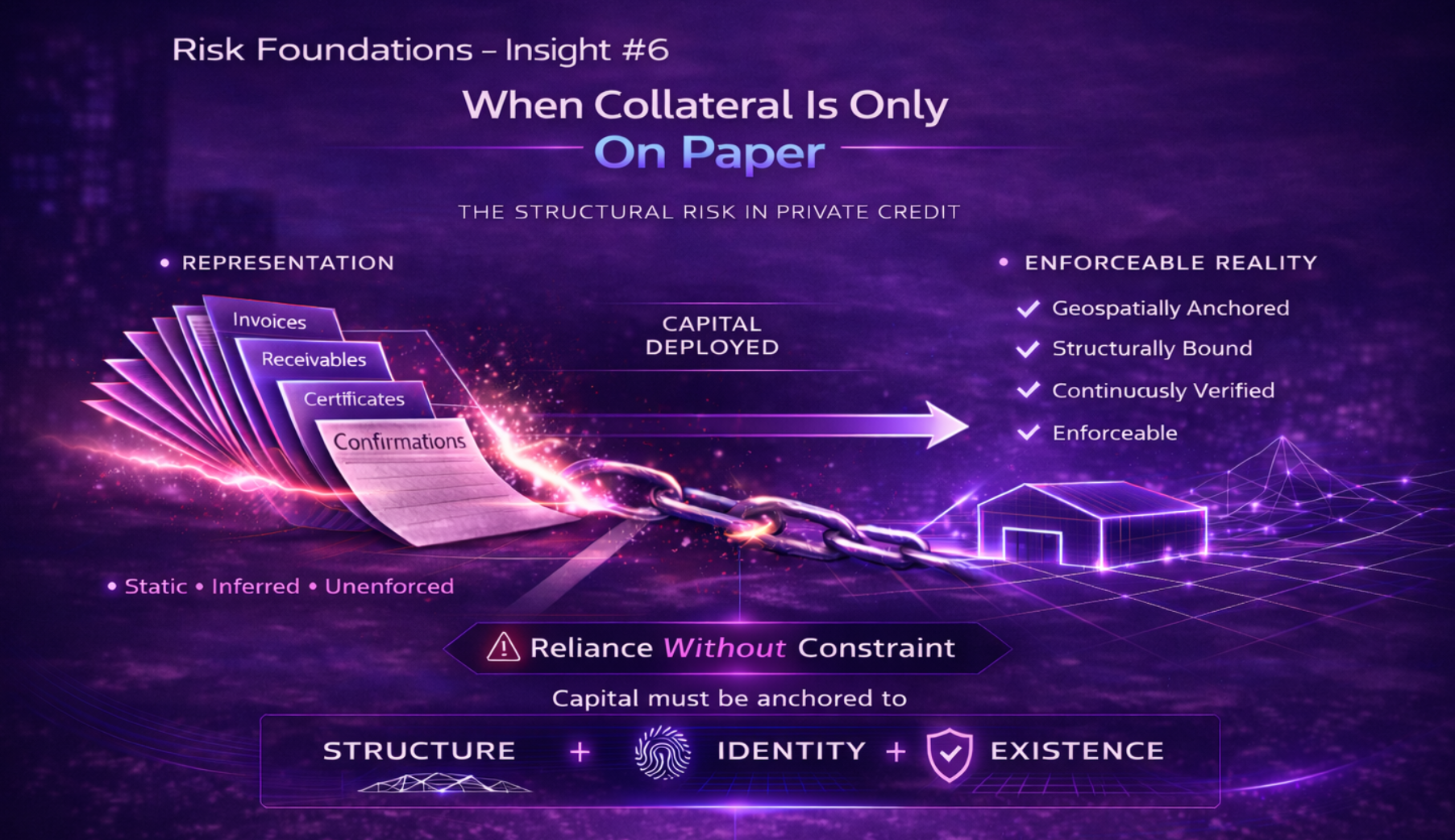
In earlier insights, we explored when risk forms, why inventory only exists while continuously constrained, why location must be proven first, and why documentation must be bound to verified existence. This piece moves one step deeper: even when assets and documentation are verified, verification itself cannot persist without persistent identity.

When a global asset manager lends against receivables that may not have existed, the issue is not sophistication. It is structure.
Recent reporting around BlackRock and its private credit arm, HPS Investment Partners, highlights a familiar pattern: capital was advanced against invoices that allegedly represented receivables from major telecom counterparties. Court filings suggest those invoices may have been fabricated. The U.S. Department of Justice is now investigating.
If the allegations prove accurate, this would not simply be a fraud story. It would be a structural risk story.
And the structure is what matters.
Private credit has expanded rapidly over the past decade. Direct lenders now finance everything from infrastructure to receivables to specialty trade flows.
Many of these facilities rely on:
The mechanism appears sound:
1. A borrower presents receivables.
2. A lender verifies documentation.
3. Capital is advanced against those receivables.
4. Repayment occurs when invoices are settled.
But this entire structure assumes something fundamental:
That documentation represents enforceable economic reality.
Documentation records what was true — it does not guarantee what remains true.
And it certainly does not prove that something ever existed at all.
Invoice fraud is often framed as:
But structurally, it is something deeper.
It is reliance on representation without enforceable constraint.
The alleged case illustrates the most extreme form: collateral that may never have existed.
However, there is a spectrum:
In each scenario, exposure formed because existence was assumed — not enforced.
As discussed previously:
Risk does not fail when loss occurs.
It fails when binding decisions are made before truth is enforced.
In receivables lending, the binding moment is the capital draw.
Receivables are intangible claims.
Unlike physical inventory, they are not bounded by space. They are bounded by documentation.
That makes them structurally more vulnerable.
There is no warehouse to inspect.
No structural boundary to verify.
No physical capacity constraint to test.
The only constraint is trust in documentation.
As AI tools make fabrication easier, representation becomes cheaper than verification.
The problem is no longer whether invoices look real.
The problem is whether they are anchored to persistent, independently verifiable economic identity.
Risk does not fail when loss occurs.
It fails when binding decisions are made before truth is enforced.
Receivables typically rely on:
But these references do not create machine-verifiable, persistent identity.
Without identity:
Periodic verification applied to dynamic exposure does not constrain risk.
It delays discovery.
If a sophisticated global asset manager can allegedly be exposed to fabricated receivables, smaller lenders, family offices, and regional funds are structurally more vulnerable.
But the lesson is not “increase manual review.”
Manual review does not scale against:
The lesson is structural:
Trust cannot be built on static documents in dynamic systems.
It is important to be clear: Sphere is not an invoice validation platform.
This case concerns intangible receivables. Sphere governs physical commodity markets — where storage, inventory, and infrastructure must be continuously anchored to geospatial identity and structural constraint before capital is deployed.
Sphere was built around one foundational premise:
Existence must be continuously enforced before reliance becomes binding.
In physical collateral markets, that means:
The structural lesson in this receivables case remains universal: where reliance is based solely on representation without enforceable constraint, exposure forms.
In physical markets, that constraint must begin with location truth.
The next generation of risk systems will not rely solely on:
They will require:
Whether the asset is inventory, infrastructure, or revenue, capital must be anchored to something structurally enforceable.
Otherwise, paper can move faster than reality.
Fraud does not increase because systems are careless.
It increases because representation becomes easier to fabricate while verification remains manual.
The private credit boom has exposed this gap.
AI will widen it further.
Markets will respond in one of two ways:
1. More documentation.
2. Or structural proof.
Only one scales.
$430 million is a headline number.
But the structural issue is older — and larger — than any single case.
Capital was deployed against representation.
Reality was not structurally enforced.
As markets accelerate and documentation becomes easier to fabricate, the gap between representation and enforceable truth will widen.
Risk does not accumulate because firms lack intelligence.
It accumulates because systems allow reliance before constraint.
In physical collateral markets, that constraint must begin with a persistent identity and continuous enforcement of existence.
That is the structural shift now underway.
And that is the foundation Sphere was built on.
Disclaimer
This article is intended for general informational and educational purposes only. It discusses observed industry patterns and structural risk considerations and does not constitute legal, financial, or investment advice. References to losses or failures are illustrative and non-exhaustive, and do not refer to any specific organisation unless expressly stated.