
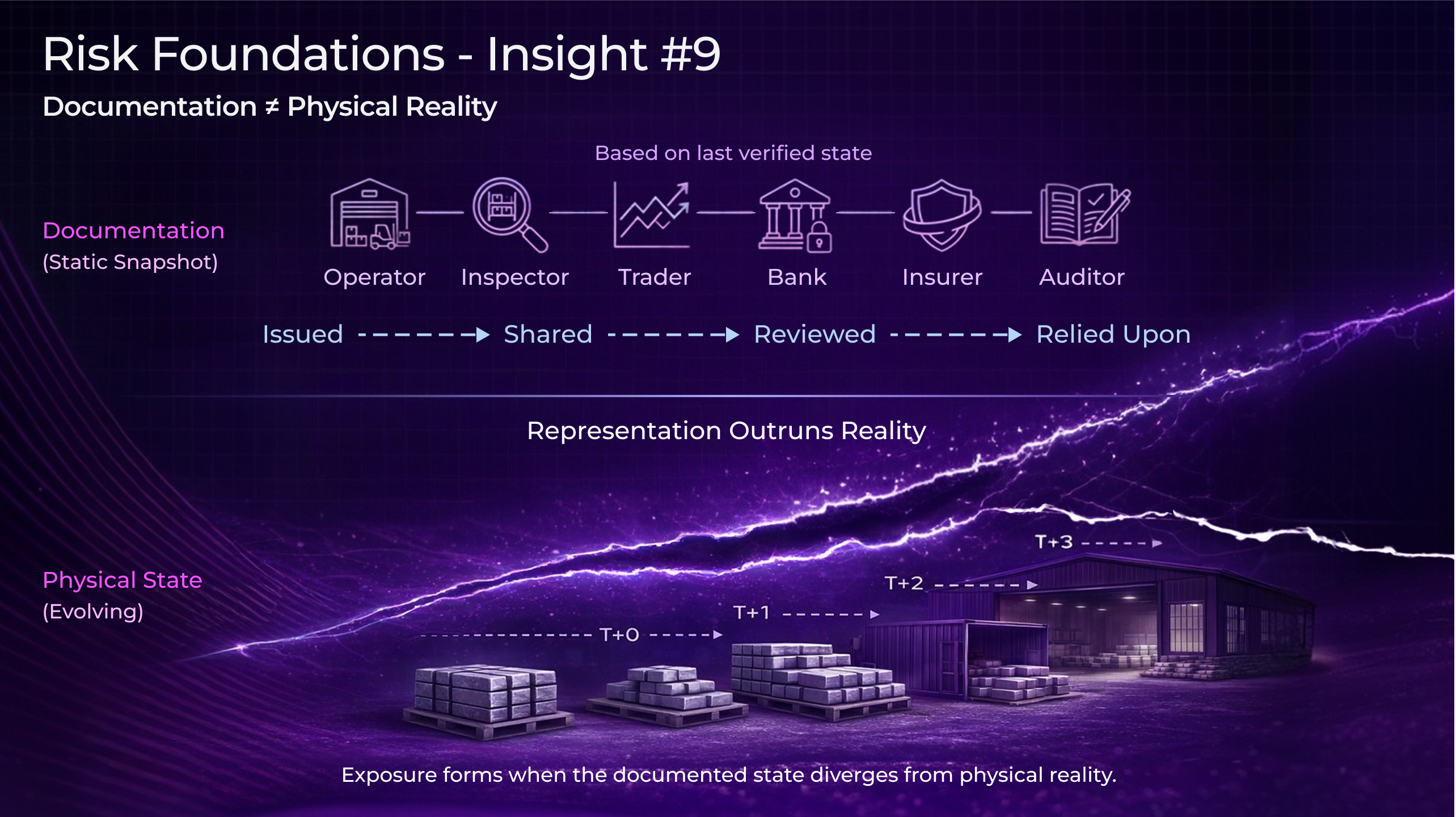
In the previous insight, we explored why commodity markets lack a shared, enforceable version of physical truth. Verification occurs across many participants but rarely accumulates into a single foundation all can rely on. Even when verification is performed correctly, a structural gap remains: financial systems move at the speed of documentation, while collateral moves at the speed of reality. The gap between them is where exposure forms.

Commodity finance operates through documentation.
Often these documents still exist as original physical instruments — warehouse receipts, bills of lading, inspection certificates, and other title or collateral documents.
These documents allow institutions to represent physical assets within financial systems.
Once created, they move quickly.
Documents may be transmitted, copied, referenced, or relied upon across institutions even while the underlying physical collateral remains unchanged.
Warehouse receipts.
Inspection reports.
Borrowing base certificates.
Stock statements.
Trade confirmations.
Collateral schedules.
Credit decisions, financing approvals, and collateral reliance therefore occur at the speed of documentation.
In financial systems, paper moves quickly.
When reliance occurs through documentation:
Decisions move at the speed of paper.
Reality does not.
Physical collateral does not move the same way.
Commodity inventories exist within dynamic physical environments.
Inventory moves through supply chains.
Cargoes change ownership mid-voyage.
Storage layouts evolve.
Access conditions change.
Operational controls weaken or strengthen over time.
These changes occur continuously.
But verification of those conditions does not occur continuously.
Inspections are periodic.
Reporting cycles are scheduled.
Audits are retrospective.
Physical verification, therefore, operates on a slower cadence than the financial systems that rely upon it.
Reality moves at the speed of operations, not documentation.
The structural gap emerges when financial reliance occurs faster than physical verification.
Documents may represent conditions that were true at the moment they were created.
But the physical environment those documents describe may already be evolving.
Inventory may move.
Collateral may be pledged elsewhere.
Operational conditions may change.
Yet the document continues to circulate.
And the financial system continues to rely upon it.
By the time verification occurs again, reliance may already have taken place multiple times.
When finance moves faster than verification:
Representation begins to outrun reality.
Exposure begins to accumulate.
Historically, the difference between paper speed and physical speed was manageable.
Documentation travelled slowly.
Decisions took time.
Verification cycles were closer to operational activity.
That balance is changing.
Commodity markets now operate with:
Information now moves faster than ever before.
Physical verification does not.
Inspectors cannot travel at the speed of digital documentation.
Storage conditions cannot be reassessed every time a document is transmitted.
As documentation accelerates, the gap between representation and enforceable reality widens.
Most verification mechanisms in commodity markets remain periodic.
They rely on:
These processes confirm what was true at a specific moment in time.
They do not ensure those conditions remain enforceable when reliance occurs.
As financial systems accelerate, the interval between verification events becomes increasingly significant.
Reliance can occur many times before reality is revalidated.
This speed mismatch does not necessarily produce immediate failure.
Instead, it allows exposure to accumulate quietly.
Collateral may appear valid within documentation cycles even as physical conditions drift.
Multiple parties may rely on the same representation before the underlying physical reality is reassessed.
In many commodity losses, the issue is not that documentation was false when it was created.
The issue is that reliance continued after reality had already changed.
Commodity markets do not need slower financial systems.
They need systems that ensure reliance cannot move faster than enforceable physical reality.
This requires infrastructure capable of:
When physical reality is continuously enforced, documentation becomes a representation of a system that remains actively verified.
The speed of paper no longer determines the reliability of collateral.
Reality does.
Commodity finance has historically operated at the speed of documentation.
Physical collateral operates at the speed of reality.
When those speeds diverge, representation begins to outrun enforceable truth.
And when reliance continues while verification lags, exposure accumulates quietly inside the system.
The next generation of market infrastructure must close this gap — ensuring that financial reliance cannot move faster than the physical conditions it depends upon.
Sphere was built to address this structural challenge.
By anchoring physical infrastructure and inventory to persistent geospatial identity and continuously verifiable constraints, Sphere enables verification to persist even as documentation moves instantly across markets.
When reliance remains anchored to enforceable reality, the speed of paper no longer creates exposure.
Truth moves with the system.
Disclaimer
This article is intended for general informational and educational purposes only. It discusses observed industry patterns and structural risk considerations and does not constitute legal, financial, or investment advice. References to losses or failures are illustrative and non-exhaustive, and do not refer to any specific organisation unless expressly stated.