
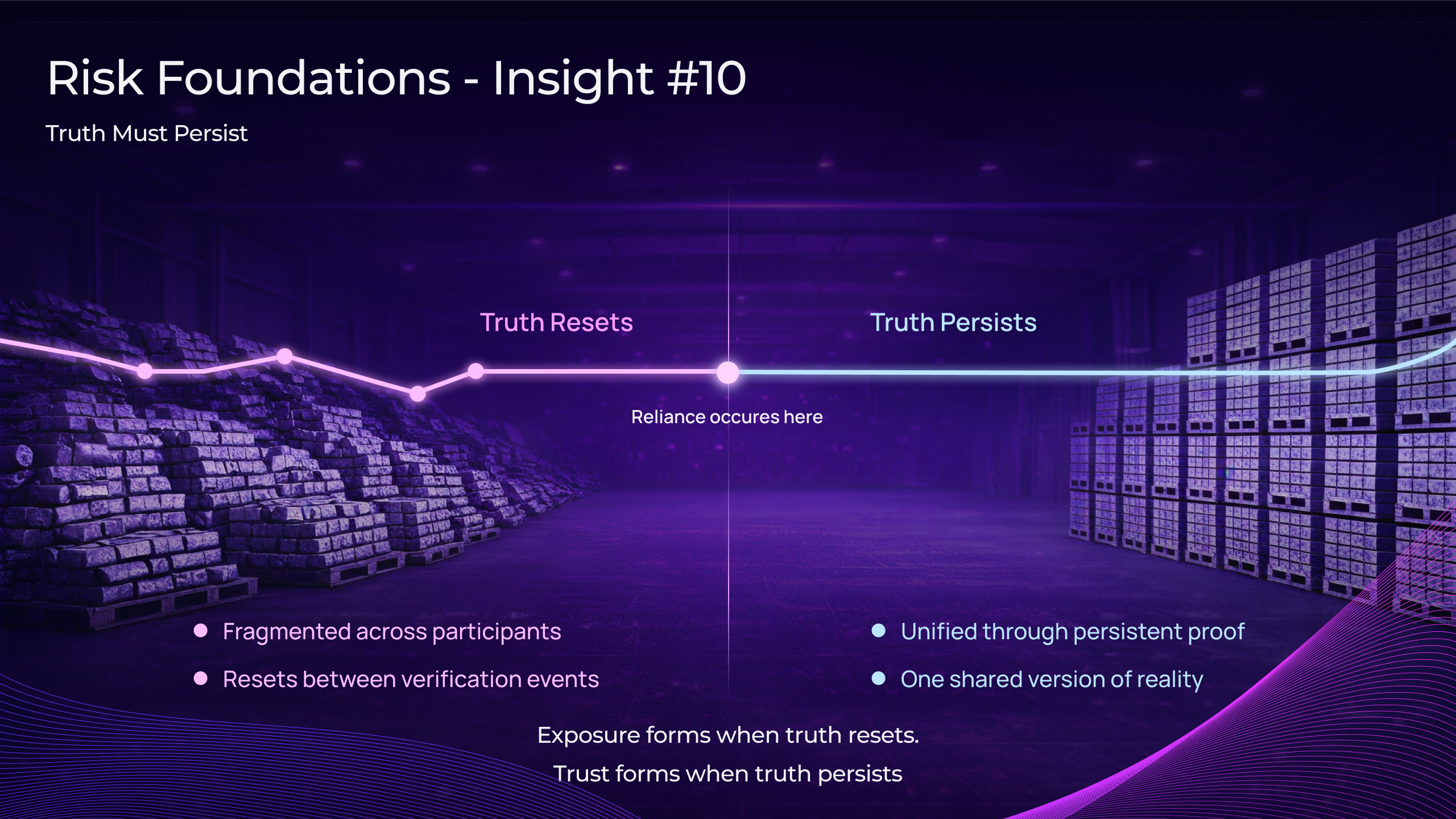
Across this series, we have explored how risk forms in commodity markets — not at the point of loss, but when reliance becomes binding. Each insight points to the same structural condition: documentation, verification, and representation do not persist as physical reality changes. Commodity markets operate without a shared, continuously enforceable version of truth. And when truth does not persist, exposure forms.

In today’s market structure:
Verification occurs.
But it does not accumulate.
Documentation exists.
But it is not bound to a continuously enforced reality.
Participants rely on collateral.
But each relies on a different version of it.
Physical systems evolve continuously.
But verification remains periodic.
As a result, truth is repeatedly recreated — not maintained.
Each inspection, report, or document establishes what was true at a moment in time.
But no mechanism ensures that truth remains valid when reliance occurs.
Despite advances in systems and controls, the underlying pattern observed in major commodity losses remains consistent.
Exposure forms when reliance is placed on representations that are no longer fully aligned with enforceable physical reality.
Over time, innovation has largely focused on improving the security, transmission, and integrity of documentation.
These developments strengthen how information moves.
They do not ensure that what is being relied upon remains true.
Encryption protects the document.
It does not prove the asset.
As a result, the structural conditions that allow exposure to accumulate have not fundamentally changed.
As markets evolve:
Innovation has improved how information moves.
It has not ensured that what is relied upon remains true.
This structure does not immediately produce failure.
It allows exposure to build quietly.
Inventory may appear valid across multiple systems.
Documentation may remain internally consistent.
Verification may have been correctly performed.
Yet the underlying physical conditions may already have changed.
When reliance continues while enforceability has already drifted:
Representation begins to diverge from reality.
Multiple parties may rely on the same asset.
Exposure accumulates before it becomes visible.
This is not primarily a failure of judgement.
It is a consequence of systems that allow reliance without continuously enforced truth.
When reliance outlives reality:
Representation begins to diverge from enforceability.
Exposure accumulates before it becomes visible.
Commodity markets have historically operated through:
These mechanisms were sufficient when:
That balance no longer holds.
Today:
But verification remains periodic.
And physical reality continues to evolve independently.
The gap between representation and enforceable truth is widening.
The solution is not more documentation.
Nor more frequent manual review.
It is a structural shift in how truth is established and maintained.
From:
To:
In this model, verification does not reset.
It accumulates.
Documentation does not stand alone.
It remains bound to current physical conditions.
Reliance is not permitted to move ahead of enforceability.
The structural shift:
From representation of reality
To continuous enforcement of reality
The distinction is fundamental.
Observation describes what was true.
Enforcement ensures what remains true.
Commodity markets have historically relied on observation.
The next generation of infrastructure must operate on enforcement.
This requires systems capable of:
When these conditions are met:
Truth no longer needs to be recreated.
It persists.
When truth persists:
Verification compounds rather than resets.
Participants no longer rely on independent assumptions.
Exposure cannot accumulate invisibly between verification cycles.
Trust becomes structural — not inferred.
The reliability of collateral is no longer determined by the speed of documentation.
It is determined by the continuous enforceability of physical reality.
Commodity markets do not fail because they lack information.
They fail because truth does not persist.
As long as reliance is allowed to move faster than continuously enforced reality, exposure will continue to form.
The future of commodity risk is not more verification.
It is ensuring that verification endures.
Truth must persist — or risk will.
Sphere is designed to provide that foundation.
By enabling a shared, continuously verified view of physical reality across the ecosystem, Sphere allows verification to accumulate rather than reset — ensuring participants rely on the same enforceable state, not independent representations.
Disclaimer
This article is intended for general informational and educational purposes only. It discusses observed industry patterns and structural risk considerations and does not constitute legal, financial, or investment advice. References to losses or failures are illustrative and non-exhaustive, and do not refer to any specific organisation unless expressly stated.